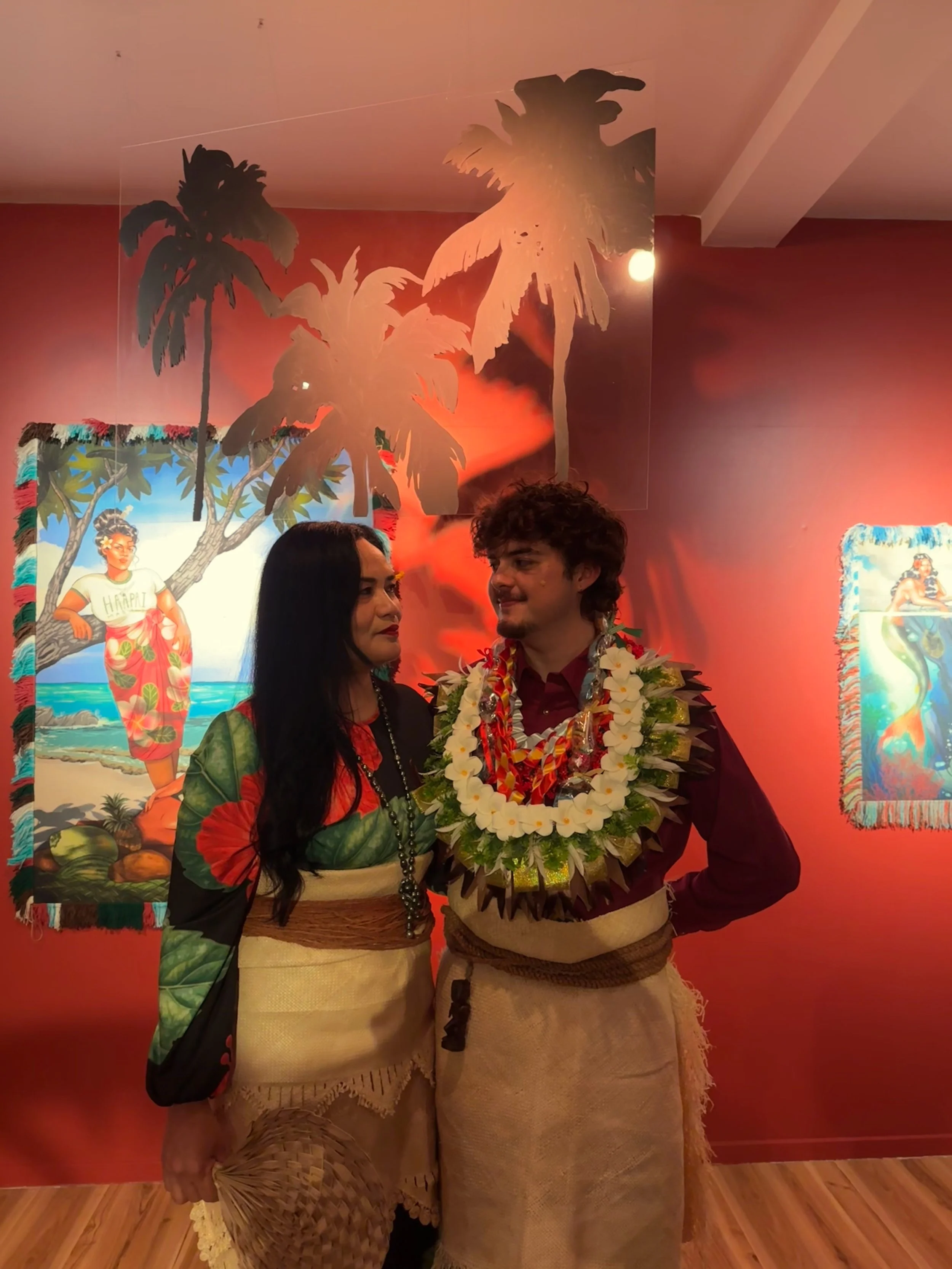
Luca Tu’avao Walton is a Fiji born, Aotearoa New Zealand-based artist of Tongan and Pākeha heritage whose work focuses on portraiture and Pacific identity. While he was raised Lagoon-side in Mataika, Nuku’alofa Tonga, he traces his family to the villages of Lotofoa, Koulo, Holopeka, Pangai, and Lofanga in Ha’apai, and Tefisi in Vava’u. These places continue to inform the people, landscapes, and stories that appear throughout his practice.
His upbringing in the lagoon-side hamlet of Mataika, Tongatapu has been a significant source of inspiration. Luca continues to draw from the beauty, strength and character of the Pasifika women who have played important roles in his life, bringing these influences into his portraiture, imagined worlds and wider visual practice.
Working primarily through digital illustration and large-scale portraiture, Luca has developed an independent practice spanning fine art, illustration, publishing, public art, apparel and community-focused projects. His work has included children’s book and educational illustration, as well as commissions and collaborations with Auckland Council, the Ministry of Education, Tamaiti, Archive by Dan Ahwa and other creative and Pasifika-led organisations. His public-facing work has included Auckland Council projects, a heritage installation at the Ellen Melville Centre and a large-scale mural on Pitt Street, opposite the new Karangahape Road CRL station, created to welcome visitors into the precinct and contribute to its visual identity.
In August 2026, Luca unveiled his first solo exhibition, Between Tree and Tide, at Fibre Gallery in Ōtautahi Christchurch. The exhibition marked a pivotal moment in his practice, bringing his digital image-making into conversation with Tongan fibre traditions, immersive installation and material processes. This has opened a new direction in his work, exploring the relationship between digital image-making, material, memory and inherited cultural knowledge.
Across these different forms, Luca’s practice remains grounded in a desire to create images that feel recognisable, lived-in and connected to the people and places that shaped him.
His work sits between personal memory and contemporary Pasifika life, drawing from the visual language of his childhood while continuing to find and evolve new ways to represent Pacific people, stories and experiences.